
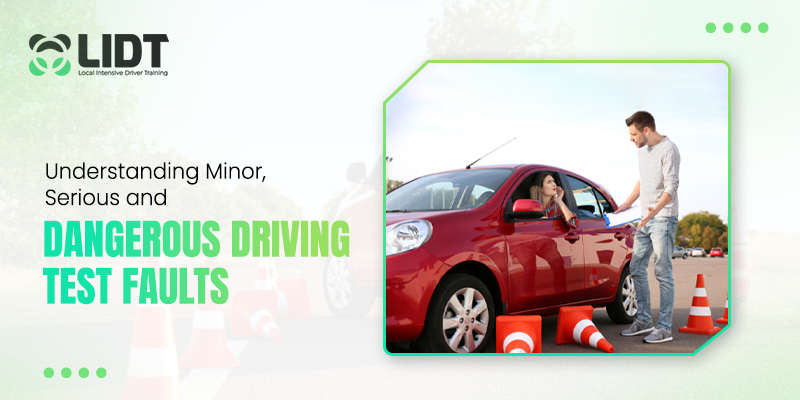
The focus of your driving test isn’t only about controlling your vehicle in a straight line or stopping when the traffic light turns red. It shows the examiner that you are capable of being a safe and responsible operator on all types of roads. The twist here? An applicant for a driving test does not have to operate their vehicle perfectly to complete the test. The most important factor in determining if an applicant passes or fails the driving test is their ability to identify the differences between minor fault(s), major fault(s), and dangerous fault(s).
An examiner will make their decision during a driving test based on these three types of faults. If you have an upcoming driving test or are considering taking a one-week intensive driving course, learning about these three types of faults could be what makes the difference between passing and taking another driving test. Let’s get started.
What Are the Faults During Driving Tests?
While some faults may be minor mistakes, others can cause immediate failure. Being aware of these fault categories can help you remain calm and make better decisions.
Minor Faults
Minor faults are small errors made while driving, which do not pose any risk to other drivers or pedestrians; thus, you may pass your one-week intensive driving even if you commit up to 15 minor faults.
Examples of minor faults include:
- Lightly Clips Kerb
- Stalling in a Safe Situation Once Only
- Forgetting to Check Mirrors Once
- Slight Hesitation at a Junction
- Serious Faults: Danger or Potential for Danger (Automatic Fail)
Serious Faults
If you make a serious mistake, you made a mistake that posed a potential danger, even if it didn’t happen at that moment. The assumption is that if you made one serious fault, you failed even if everything else you did on your drive was perfect. However, if you’re short on lesson time, consider taking a one week intensive driving course to tackle weaknesses quickly.
Some examples of serious faults are:
- Not looking over your right shoulder (blind spot) before changing lanes
- Pulling out from a junction, making another driver brake
- Choosing the wrong lane at a roundabout
Dangerous Faults
This is considered the worst type of fault. A dangerous fault puts you, the examiner and everyone else on the road in immediate danger. If you make one dangerous mistake, you have failed your test, and the examiner can stop your test immediately. Thus, to learn effectively, don’t forget to book theory test early to avoid waiting lists.
Some examples of dangerous faults are:
- Driving through a red traffic light
- Causing another vehicle to brake
- Driving aggressively onto the footpath when there are pedestrians present.
The Bottom Line
By knowing the difference between the three types of driving faults (minor, serious, and dangerous), you can focus on driving safely rather than attempting to achieve a “perfect” result. Therefore, it is essential to be aware of these types of errors and to be able to observe them.
If you want to boost your driving skills, learn with LIDT. We are a 5 star driving school offering a stress-free approach to learning through expert guidance, training tools, and support from approved instructors. With our one-week intensive driving course, you’ll learn more than just how to pass your driving test; you’ll learn life skills to keep you safe on the road. Start your new driving journey today with LIDT and become a more competent, safer driver.
FAQs
Q1: Can I pass with 15 minor faults?
It is possible to pass if you have received up to 15 minor faults but have not committed any serious or dangerous faults.
Q2: Is it a failure if I touch the curb?
Touching the curb lightly is considered a minor fault; however, mounting the curb may be considered a serious or dangerous fault.
Q3: Is stalling an automatic failure?
Stalling is usually considered a minor fault unless it creates danger or causes substantial delays to other road users.
Q4: If I fail the test, will the examiner cease testing me?
If you have committed a dangerous fault, your examiner will stop the test; otherwise, you will continue until the end of the test.