+321 123 4567
info@test.com
My Account
  • Home
  • Pratical Tests
  • Intensive Courses
  • Driving Lesson
  • Electric Driving Lesson
  • Theory Tests
  • Area We Cover
      • Berkshire
      • Buckingham
      • Birmingham
      • Bristol
      • Bedford
      • Cheshire
      • Cumbria
      • Cornwall
      • Cambridgeshire
      • Dorest
      • Devon
      • Derby
      • Essex
      • East Yorkshire
      • Hampshire
      • Kent
      • Lincoln
      • Leicester
      • Manchester
      • Norfolk
      • Northampton
      • Nottingham
      • North Yorkshire
      • Oxford
      • Surrey
      • Suffolk
      • Sussex
      • Shropshire
      • South Yorkshire
      • West Yorkshire
  • LIDT
    • Tesla Experience
    • About Us
    • Blogs
    • FAQ’s
    • Contact
  • Home
  • Pratical Tests
  • Intensive Courses
  • Driving Lesson
  • Electric Driving Lesson
  • Theory Tests
  • Area We Cover
      • Berkshire
      • Buckingham
      • Birmingham
      • Bristol
      • Bedford
      • Cheshire
      • Cumbria
      • Cornwall
      • Cambridgeshire
      • Dorest
      • Devon
      • Derby
      • Essex
      • East Yorkshire
      • Hampshire
      • Kent
      • Lincoln
      • Leicester
      • Manchester
      • Norfolk
      • Northampton
      • Nottingham
      • North Yorkshire
      • Oxford
      • Surrey
      • Suffolk
      • Sussex
      • Shropshire
      • South Yorkshire
      • West Yorkshire
  • LIDT
    • Tesla Experience
    • About Us
    • Blogs
    • FAQ’s
    • Contact
  • Home
  • Pratical Tests
  • Intensive Courses
  • Driving Lesson
  • Electric Driving Lesson
  • Theory Tests
  • Area We Cover
      • Berkshire
      • Buckingham
      • Surrey
      • Suffolk
      • Cheshire
      • Cumbria
      • Manchester
      • Kent
      • Bristol
      • Dorest
      • Devon
      • Cornwall
      • Bedford
      • Norfolk
      • Oxford
      • Cambridgeshire
      • Sussex
      • Birmingham
      • Northampton
      • Shropshire
      • Lincoln
      • Derby
      • Nottingham
      • Leicester
      • Hampshire
      • Essex
      • West Yorkshire
      • South Yorkshire
      • North Yorkshire
      • East Yorkshire
      • Berkshire
      • Buckingham
      • Birmingham
      • Bristol
      • Bedford
      • Cheshire
      • Cumbria
      • Cornwall
      • Cambridgeshire
      • Dorest
      • Devon
      • Derby
      • Essex
      • East Yorkshire
      • Hampshire
      • Kent
      • Lincoln
      • Leicester
      • Manchester
      • Norfolk
      • Northampton
      • Nottingham
      • North Yorkshire
      • Oxford
      • Surrey
      • Suffolk
      • Sussex
      • Shropshire
      • South Yorkshire
      • West Yorkshire
  • LIDT
    • Tesla Experience
    • About Us
    • Blogs
    • FAQ’s
    • Contact

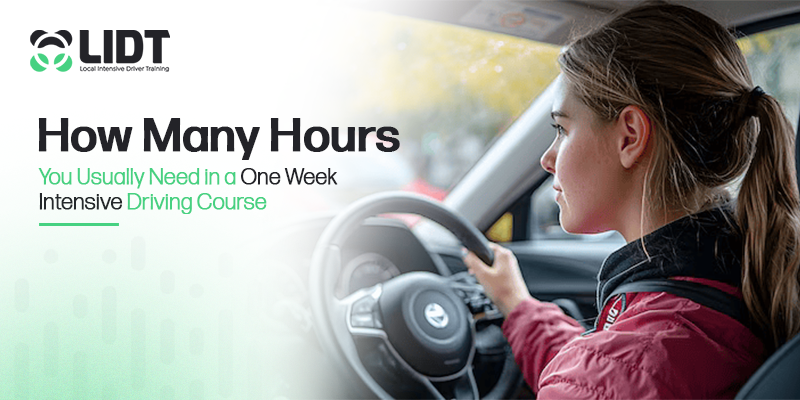
How Many Hours You Usually Need in a One Week Intensive Driving Course

Posted on 29 Jan at 10:11 am
No Comments
one week driving crash course London

A one-week course sounds simple on paper. Book it, show up, learn fast, pass quickly. In real life, it depends. People learn at different speeds, nerves show up at the worst times, and London traffic has its own personality. Still, there are typical hour ranges that most learners can use as a starting point.

Now, let us look at the usual hours needed in a one week driving crash course London, what changes the total hours, and how to plan the week without burning out.

Typical Hours Most Learners Need

Most one-week intensive programmes run somewhere between 20 and 40 hours of driving practice. That’s the common window. On the lower end, a learner might already have some experience and just needs polishing. On the higher end, someone could be starting fresh and needs more time to build confidence with clutch control, junctions, and roundabouts.

For anyone searching 1 Week intensive driving course London, it’s worth checking what’s included. Some packages are “driving hours only”, while others include theory help, mock tests, or even the test booking. Those details change the experience, even if the headline hours look similar.

What Makes The Hour Count Go Up Or Down

A few things can shift the total hours quite a bit:

Previous Driving Experience

If a person has driven before (even informally), they often need fewer hours. They are not learning from zero, just sharpening skills and fixing habits.

Confidence And Nerves

Some learners can technically drive well, but nerves make them hesitate. That usually means they need extra time for consistency. It’s normal. Annoying, but normal.

Test Readiness And Instructor Pace

A good instructor won’t rush someone just to “finish the week”. They’ll set a pace that matches how fast the learner is improving. People looking for a One week driving crash course London should check if the schedule includes mock tests and independent driving practice, because that’s where real readiness shows.

A Sensible Weekly Breakdown

Here’s a realistic structure many courses follow:

  • Mon–Tue: Basics, clutch control (if manual), moving off, stopping, steering, simple junctions
  • Wed–Thu: Busier roads, roundabouts, lane discipline, speed control, manoeuvres
  • Fri–Sat: Mock tests, weak area focus, independent driving, test preparation

That often works out to 4–6 hours per day, with breaks. Without breaks, the brain turns to mush. Nobody learns well when they’re tired and irritated.

Conclusion: How To Know If It’s Too Much Or Too Little

A quick self-check helps: after a lesson, does the learner remember what improved and what needs work? If everything feels like a blur, the schedule might be too intense. If progress feels slow, they may need more hours or a different focus.

Anyone booking 1 Week intensive driving course London should ask one blunt question: “How many hours do you recommend for my level, and why?” A clear answer usually means they’re dealing with a solid provider.

If you want to pass quickly without feeling rushed, we can help you choose the right course length and build a plan around your current skill level. At LIDT, we offer one-to-one intensive training with DVSA-approved instructors, plus support with fast-track test booking. Check out our intensive courses and get started today!

FAQs

Can a beginner pass in one week?

It’s possible, but it depends on confidence, practice hours, and how quickly skills settle in.

Is 20 hours enough for a one-week course?

For learners with prior experience, it can be. For complete beginners, 20 hours may feel tight.

How many hours per day is normal?

Usually 4–6 hours daily with breaks, depending on the course plan and learner stamina.

Should someone do theory during the same week?

If theory isn’t done, it can add stress. Many learners prefer passing theory first.

Do intensive courses include the driving test?

Some do, some don’t. Always check what the package includes before paying.

Previous Post
What to Take to Your Theory Test So You Do Not Lose Your Fee

Leave a Reply Cancel reply

Your email address will not be published. Required fields are marked *

Fill out this field
Fill out this field
Please enter a valid email address.
You need to agree with the terms to proceed

Recent Posts

  • How Many Hours You Usually Need in a One Week Intensive Driving Course January 29, 2026
  • What to Take to Your Theory Test So You Do Not Lose Your Fee January 27, 2026
  • 5-Day Intensive Driving Course: Who It’s For And Who Should Avoid It January 24, 2026
  • 1 Week Driving Course London: Beginner vs Part-Trained Which Plan Works Best January 21, 2026
  • Car Maintenance Tips: What Should You Know As A Driver? December 29, 2025

Categories

  • Blog (119)
355 Commercial Road
London E1 2PS
Email: info@lidt.co.uk
Facebook
Google
Twitter
Instagram
YouTube
LinkedIn
Copyrights © 2021 All Rights Reserved by LIDT.
  • Terms of Use
  • Privacy Policy
  • Home
  • Practical Tests
  • Intensive Courses
  • Driving Lessons
  • Theory Tests
  • Contact